Excerpt from the South Carolina Declaration of Secession:
The General Government, as the common agent, passed laws to carry into effect these stipulations of the States. For many years these laws were executed. But an increasing hostility on the part of the non-slaveholding States to the institution of slavery, has led to a disregard of their obligations, and the laws of the General Government have ceased to effect the objects of the Constitution.
A geographical line has been drawn across the Union, and all the States north of that line have united in the election of a man to the high office of President of the United States, whose opinions and purposes are hostile to slavery.
We, the People of the State of South Carolina, in Convention assembled do declare and ordain, and it is hereby declared and ordained, That the Ordinance adopted by us in Convention, on the twenty-third day of May in the year of our Lord One Thousand Seven hundred and eighty eight, whereby the Constitution of the United States of America was ratified, and also all Acts and parts of Acts of the General Assembly of this State, ratifying amendment of the said Constitution, are here by repealed; and that the union now subsisting between South Carolina and other States, under the name of "The United States of America," is hereby dissolved.
Lincoln responds to the unrest in his Inaugural Address:
Apprehension seems to exist among the people of the Southern States that by the accession of a Republican Administration their property and their peace and personal security are to be endangered. There has never been any reasonable cause for such apprehension. Indeed, the most ample evidence to the contrary has all the while existed and been open to their inspection. It is found in nearly all the published speeches of him who now addresses you. I do but quote from one of those speeches when I declare that--
I have no purpose, directly or indirectly, to interfere with the institution of slavery in the States where it exists. I believe I have no lawful right to do so, and I have no inclination to do so.
Resolved, That the maintenance inviolate of the rights of the States, and especially the right of each State to order and control its own domestic institutions according to its own judgment exclusively, is essential to that balance of power on which the perfection and endurance of our political fabric depend; and we denounce the lawless invasion by armed force of the soil of any State or Territory, no matter what pretext, as among the gravest of crimes.
Again: If the United States be not a government proper, but an association of States in the nature of contract merely, can it, as acontract, be peaceably unmade by less than all the parties who made it? One party to a contract may violate it--break it, so to speak--but does it not require all to lawfully rescind it?
Descending from these general principles, we find the proposition that in legal contemplation the Union is perpetual confirmed by the history of the Union itself. The Union is much older than the Constitution. It was formed, in fact, by the Articles of Association in 1774. It was matured and continued by the Declaration of Independence in 1776. It was further matured, and the faith of all the then thirteen States expressly plighted and engaged that it should be perpetual, by the Articles of Confederation in 1778. And finally, in 1787, one of the declared objects for ordaining and establishing the Constitution was "to form a more perfect Union."
But if destruction of the Union by one or by a part only of the States be lawfully possible, the Union is less perfect than before the Constitution, having lost the vital element of perpetuity.
It follows from these views that no State upon its own mere motion can lawfully get out of the Union; that resolves and ordinances to that effect are legally void, and that acts of violence within any State or States against the authority of the United States are insurrectionary or revolutionary, according to circumstances
...
I am loath to close. We are not enemies, but friends. We must not be enemies. Though passion may have strained it must not break our bonds of affection. The mystic chords of memory, stretching from every battlefield and patriot grave to every living heart and hearthstone all over this broad land, will yet swell the chorus of the Union, when again touched, as surely they will be, by the better angels of our nature.
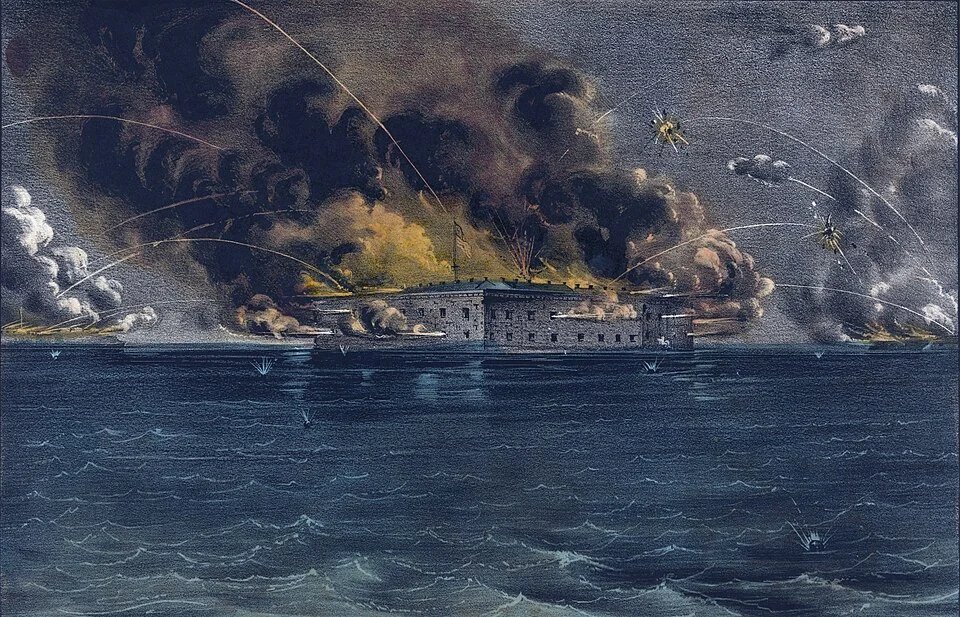
On April 11th, 1861, Fort Sumter and the Federal troops stationed there were bombarded by South Carolinian forces and forced to surrender, suffering no casualties in men. It is finally clear to all that war is upon us!
A house divided against itself, cannot stand.
I believe this government cannot endure permanently half slave and half free.
I do not expect the Union to be dissolved – I do not expect the house to fall – but I do expect it will cease to be divided.
It will become all one thing or all the other.