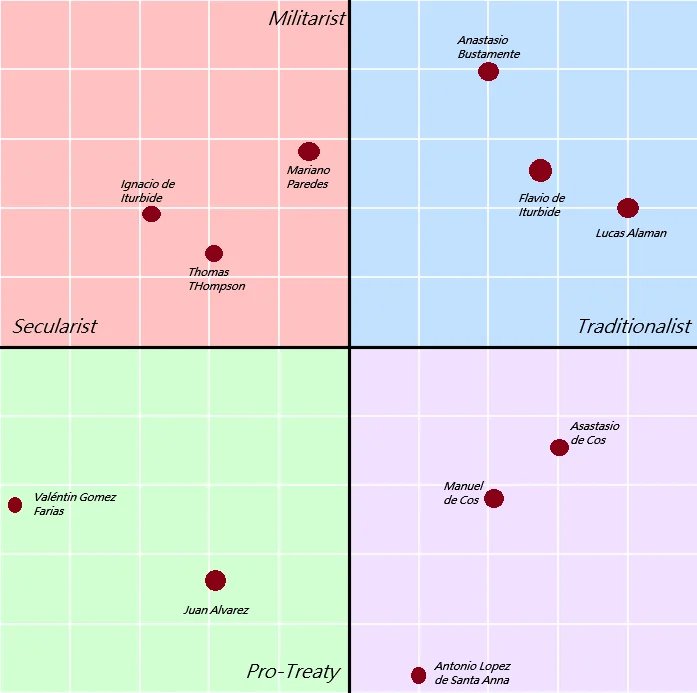
A decade ago Mexican politics had a single fault line. On one side Centralist, pro-Church conservatives; and on the other Federalist, secularist liberals. It was a simpler time.
At the time that Antonio Lopez de Santa Anna negotiated a massive land sale to the United States for 45 million U.S. dollars, paid over twenty years, the ruling Conservative coalition was completely dominant and completely united. But that all started to fall apart in the long months that ratification debates dragged on.
Hardline jingoists in the military and landowning elite, affronted by the “capitulation” to an expansionist neighbor, suddenly found common cause with liberals who decried the expansion of slavery across North America. Among those “liberals” were millions of devout Catholics, usually committed conservatives, who saw Mexico’s deal with Protestant slavers as akin to Judas accepting his chest of silver.
This is what ex-President Valentin Gomez Farias found when he returned from exile and met with Santa Anna in Veracruz. Farias was able to rally demoralized liberals to the side of peace but argued that **the issue was too important to be decided without the full consent of the people, and no Treaty should be ratified before new elections were held.** Santa Anna was forced to either stick to his Centralist guns, or flip sides *once again* and throw in with the liberals to push the Treaty through.
It took more than two years just to have elections called. Presidente Miguel Barragan’s declining health left him indisposed for long periods but he was firmly in the Jingoist camp, and refused to hand Santa Anna the powers to force through his grand bargain. But tenant farmers and a pro-peace wing of the Catholic Church kept staging mass protests that threatened to destabilize the country once again, and Santa Anna's wing of the military threatened to pull support for th egovernment entirely. To avert total civil war, in 1841 new elections were finally held.
Conservatives won decisively but “pro-treaty” conservatives held only the slimmest majority. Final ratification, years after the time frame Santa Anna and the United States agreed to, required massive liberal support. This “treachery” toppled and re-aligned the Congress leadership several times. By the 1845 election “Santanistas” were effectively running as a third party based on moderate conservatism, pro-American foreign policy, and more than a little cult of personality. Liberals won this three-way race with a bare plurality, and Valentin Gomez Farias assumed the Presidency for the second time.
The treaties have been signed, the lands transferred and the payments begun; but Mexico remains just as polarized as before. Farias attempts to pivot to his signature issue, of once again rolling back the excess privileges of the Church. Despite assurances that this is a “moderate” reform, the religion vs. secular question is already splitting the pro-peace coalition that brought liberals back into power. Whether Mexico can begin to heal and move forward, or become frozen by resentment and factionalism, remains to be seen.









 United States of America