The inner stability at the Khalsa's Raj politics seems to get more complicated every day it passes, and it doesn't seem to stop degrading month by month.
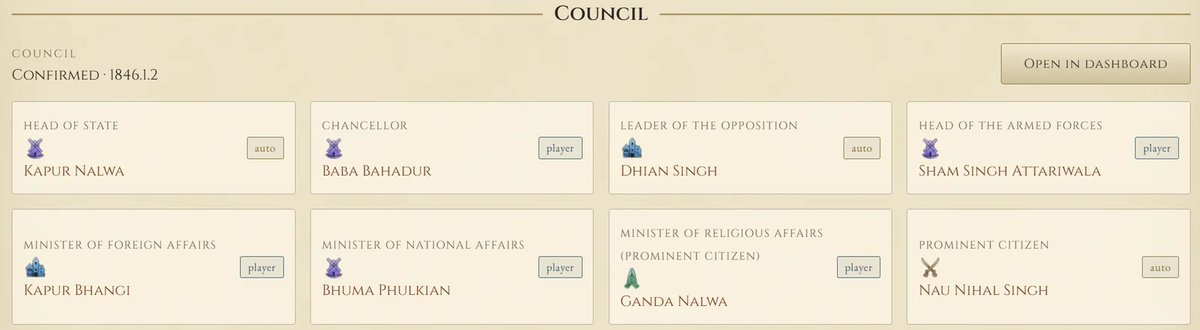
The unpopular Rajah Kapur Nalwa, who is mostly considered as an illegitimate puppet and a Maratha's Maharajah's pawn by the Khalsaji, the Petit Bourgoisie, the Jats and the Intelligentsia; had kept a transitional cabinet team from May 1st 1838. This transitional cabinet lasted until the current date of 1846, in which Raj Kapur Nalwa has finally decided to present the full governmental cabinet expected to last for the next 10 years, and the political appointments have certainly been a shock to many.
The new cabinet has replaced important figures of the both the previous and the transitional administration.
The government:
1- The Chancellor position had changed from a moderate anti-Maratha member of the Khalsaji, Kharak Singh, to a temporal transitionary member in Datar Kaur -who was the main opposition of the previous Raj Ranjit Singh admnistration and who also was the leader of the moderate faction of Zamindars and a moderate member of the Marathi Empire Union-. The big surprise came today when the historical leader of the opposition got replaced by an Authoritarian Hindu chancelor named Baba Bahadur, who is a strong supporter of Maratha's control over the Khalsa Raj. This replacement caused popular outrage and seemed to indicate that the cabinet was going to be heavily influenced by the Maratha's, but the rest of the appointments tell a different story.
2-The Head of the Armed Forces position had changed from Tej Singh, an anti-Maratha candidate, to a temporal transitionary member in Alexander Gardner, an American who was put in that position to keep the rest of the seditious army happy enough so they wouldn't try to coup the new regime. Alexander Gardner was also replaced today by a moderate member of the Zamindars, Sham Singh Attariwala , who seems to be a Nalwa dynasty Loyalist and who was put there due to his commitment to defend the Nalwa dynasty above all.
3- The Minister of Foreign Affairs position had changed from Dhian Singh, a member of the Petit Bourgoisie who became famous due to his advocacy for interventionist economic reforms and geopolitically an avid anti-Maratha, to being almost left vacant for almost 8 years due to being a position usually reserved to a member of the petit-bourgeoisie (and the lack of a better candidate) until today. That position fell upon Kapur Bhangi , an authoritarian member of the Petit Bourgeoisie who was deeply anti-Maratha, to the point of being rumored to be a member of one of the leading members of Tetrads, the oppositions groups that are trying to overthrow the government. That extremely controversial picking has arisen controversy among the conservative and Pro-Maratha's groups of the Zamindats, but it's normally interpreted as a way the Rajah Kapur Nalwa tries to signal his authonomy and independence of Maratha's influence in order to gain more legitimacy and popular support.
4- The Minister of National Affairs position has changed from Tej Singh, an extremely Pro-British member of the Khalsaji, to being left vacant for 8 years due to internal politics and strife until now. Today, this position have been granted to Bhuma Phulkian, a relatively unknown and unprominent traditionalist members of the Zamindars. When asked by the press why the Rajah Kapur Nalwa decided to grant a cabinet position to a borderline irrelevant and fundamentalist member of the Zamindars, the Raj replied that it was because it was the only man who guaranteed him support to make Sikhism a State Religion. This reply of the Rajah clearly stating his intentions to abandon the traditional Freedom of Faith in favour of declaring a State Religion, alarmed and heavily radicalized the Intelligentia and the Khalsaji against the Rajah himself, and the start of the official Sikh State Religion Law caused the Khalsaji to promptly quit and abandon the government, with the sabre-rattling of a potential coup being more likely each day it passes.
5- The (unofficial until now) Minister of Religious Affairs position has been radically transformed. From a position meant to represent and guarantee the rights of Muslim minorities under the Shiite leader of the Intelligentsia Fakir Aziz al-Ud Din to a position meant to represent the power of Sikhs and to grant an special position to the Sikh faith under
Ganda Nalwa 's Traditionalist and borderline theocratic viewpoint. This change was taken as a declaration of hostilities by the Intelectuals, who are now fully commited to overthrowing the puppet Rajah, but it also hadn't really like to the Hindu Maratha's Empire supporters, who are trying to spread anti-Islamic bigotry as a way to make a reconciliation with the traditionalist and theocrats in the cabinet and who want to change the law text and title from a Sikh State Religion Law to an All-Indian State Religion law, a proposal mocked and ridiculed by Ganda Nalwa himself.
The Opposition: The Tetrads
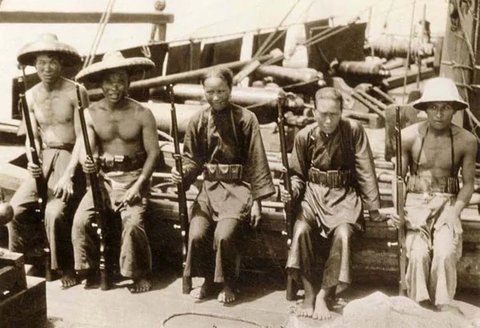
Have any of our readers ever heard of the Chinese Triads and the history of the secret societies that pledged to the chant "Down with the Qing, restore the Ming"? Well, the Tetrads are recent secret political organizations that have formed with the clear objective of overthrowing the current "illegitimate regime in Khalsa Raj" and declare independence from the Marathas.
They have been trying to articulate a Shadow Government, and they could have succeeded in overthrowing the current Raj if they would had been able to create a single unified government; but they were splintered and created several parallel governments so they had failed to create a common front until now, but after today's cabinet announcement it seems that the possibility of unity between the four tetrads seems more likely than ever before.
The four tetrads are the People's Tetrad, the Wise Tetrad, the Militant Tetrad, and the Political Tetrad.
Now, we shall like to divide in 8 groupings and organize the information of the government and the opposition according to their geopolitical leanings, specifically acording to how much Pro or Anti Maratha they're, so let's start from the most pro-Maratha to the least.
The pro Marathas:
1- The Dharma Sabhas: The Dharma Sabhas is an active militant (Traditionalist) revivalist Hinduist group. It originally formed in Calcutta, claiming militant opposition to British imperialism in the Indian subcontinent and quickly spread to Khalsa Raj's Hindu population. It is formed by Hindu characters of Minoritarian Traditionalist ideology. They are directly financed and promoted by the Maratha's Empire and they are their most ardent and zealous defenders and want the Khalsa Raj autonomy to diminish, with some proposing the Khalsa Raj to be directy annexed into the Maratha's. They advocate for total war against the British until they get completely expelled from the Indian continent.
Geopolitical stance: Extremely positive towards the Marathas; extremely negative towards British Empire, significantly negative towars Persia.
2- The Maratha Loyalists: They are mostly formed by Hindu characters of a diversity of conservative ideologies, like Authoritarian or Moderate leanings. They tend to be part of the Zamindars and support helping the Marathas resistance against any British attack, but are more pragmatic and don't actively seek war with the British but to keep the status quo so both the Maratha's Empire and Khalsa Raj survive, prefering a more defensive approach. They tend to be one of the main supporters of the pro-Maratha lobby and they want to continue being Maratha's vassals but don't desire direct annexation. They tend to be extremely islamophobic and look for an alliance with the Siks traditionalist on these terms. The current Chancellor Baba Bahadur belongs to this group.
Geopolitical stance: Extremely positive towards the Maratha; somewhat negative and wary towards British Empire, extremely negative towards Persia.
3- The Nalwaites, Royalists or Authonomists: They are formed by the majority of the Zamindars who support the Nalwa ruling dynasty and they are the core backers of the government. They are ideologically diverse but tend to be Authoritarian, Moderate or Royalists . They compose the bulk of the most moderate faction of the pro-Marathi lobby and want to increase the level of authonomy, decentralization and freedom in their relationship with the Maratha's empire, while still being loyal unless their liberty desires reaches a boiling point. The Head of the Armed Forces Sham Singh Attariwala belongs to this faction.
Geopolitical stance: Slightly positive towards the Marathas; slightly negative/ wary to neutral towards British Empire, slightly negative towards Persia.
The neutral isolationists:
4- The Sikh Fundamentalists: They are mostly members of the Zamindars and the Granthis with a Traditionalist ideology. They are the main supporters of the Sikh State Religion law and they are isolationist who tend to focus on religious and internal affairs. They tend to be islamophobic and sometimes somewhat hinduphobic. They are the most represented group in the current government administration as they control the Minister of National Affairs ( Bhuma Phulkian) and the Minister of Religious Affairs under Ganda Nalwa.
Geopolitical stance: Slightly negative towards the Marathas, neutral towards British Empire, negative towards Persia
The anti-Marathas rebels: the Tetrads:
5- The Populists: They are members of the People's Tetrad and are formed by members of the Jats, the peasant masses. They are behind the current Peasant Movement for Peasant Propietorship. They were previously pacific and part of the neutral isolationists, but after the conformation of the cabinet, they have been more radicalized against the government. The Populist are led by Fakirbhai Vaghela , a Gutharati land reformer who became the most popular political figure and who was born and came from Idar, and dreams of living the liberation of his fatherland from Marathi subjugation. Fakirbhai Vaghela is a Hindu, but he's heavily against the Marathas' current Traditionalist leadership, who he blames for their backwardness and their defeat against British imperialism. He has stated that the Indian continent could only be free from British domination if the people and the peasants are free from Indian serfdom first.
Geopolitical stance: Negative towards the Marathas, slightly negative towards the British Empire, slightly positive towards Persia.
6- The Wise sages: They are members of the Wise Tetrad, and they are formed by members of the Intelligentsia, the intelectual classes. They are religiously tolerant, have been massively polarized against the government after the Sikh State Law announcement and they have recently convinced the leader of the Populists to join them in their efforts to overthrow the government in exchange for their support towards Land Reform. The leader of the Wise Tetrad is Fakir Aziz ud-Din. Fakir Aziz ud-Din is a Shiite Punjabi, previous Minister of Religious (Minority) Affairs and a supporter of political and social reform, who is right now hidden to avoid political persecution.
Geopolitical stance: Negative towards the Marathas, neutral towards the British Empire, extremely positive towards Persia.
7- The Militarists: They are members of the The Militant Tetrad, they are Khalsaji generals and soldiers who consider the current Rajah Kapur Nalwa to be an illegitimate occupier put on the throne by the Maratha invaders. They represent the previous administration, were the staunchest supporters of the Rajah Ranjit Singh and consider the inheritance belongs to his son Kharak Singh, who is still on exile and nobody knows if he's alive, or to his grandson Nau Nihal Singh. They are staunchly against the Marathas for deposing the rightful ruler and are actively planning a coup. Their members operate with great secrecy (Nau Nihal Singh, Alexander Gardner, Paolo Avitabile, Tej Singh) and their identities are unknown.
Geopolitical stance: Extremely negative towards the Marathas, positive towards the British Empire, slightly positive towards Persia.
8- The Politicalists: They are members of the Political Tetrad, formed by members of the Petit Bourgeoisie and the Industrialists. They consider the current administration submission to the Marathas to be a humilliation to the Sikh people as a whole and they are extremely patriotic. The industrialists also admire the British Empire and want to modernize the country taking them as an example, while the Petit Bourgoisie are the ones who hold the most power in the opposition coalition. It's said that they have contact in the embassies and operate partly from exiled groups. Apparently, one of their leader, Mr. D, is the one who is behind the Shadow Government, has recently gotten the support from the Militarist to cooperate for independence and he is the main plotter and mastermind of the operation. Their members are secret (Dhian Singh and Kapur Bhangi, the official Foreign Minister) and they always have an exit plan ready if it backfires.
Geopolitical stance: Extremely negative toward the Marathas, extremely positive towars the British Empire, neutral towards Persia.
I hope our readers have really enjoyed our extremly detailed report on the inner politics of the Khalsa Raj. We cannot tell how all of this will end, but something is sure: A Khalsa Raj divided against itself cannot stand.
_________________________________________________________________________




































 Marathas